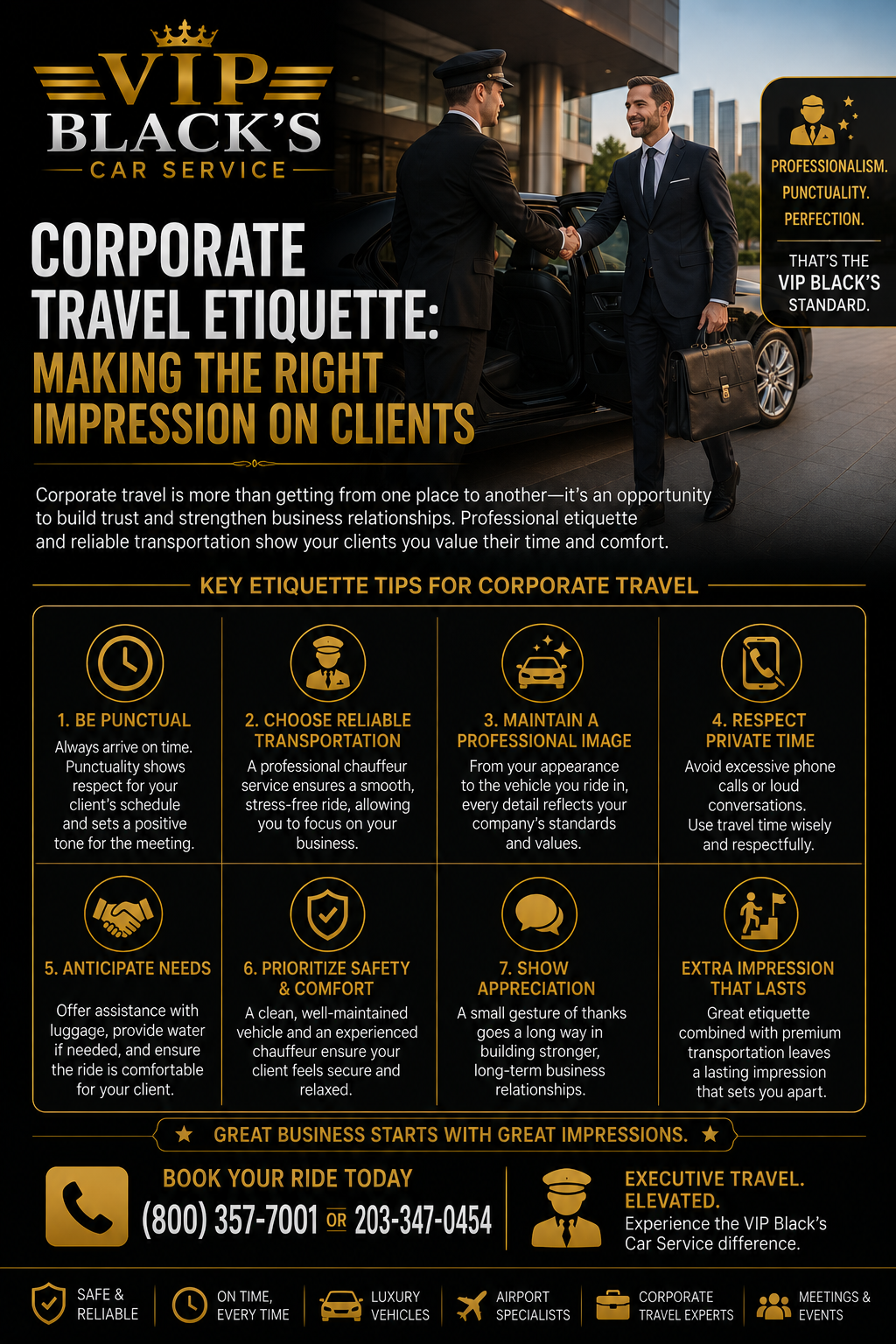
Corporate Travel Etiquette: Making the Right Impression on Clients starts long before the handshake. It starts with how you arrive, how you dress for the trip, how you handle the ride between meetings, and how you treat everyone from the front desk to your driver along the way. Clients notice more than the pitch — they notice punctuality, composure, and the small courtesies that reveal how a company actually operates. At VIP Black Car Service, we’ve chauffeured executives to thousands of client meetings across Connecticut and New York, and the pattern is clear: the professionals who make the strongest impressions treat every part of the trip, not just the meeting itself, as part of the presentation.
This guide breaks down the etiquette that matters most on a business trip, from the moment you leave the office to the moment you shake hands with a client, so every touchpoint reflects the professionalism you’re trying to project.
Why Corporate Travel Etiquette Matters More Than You Think
First impressions form faster than most professionals realize. Princeton researchers Janine Willis and Alexander Todorov found that people form lasting judgments about a stranger’s trustworthiness and competence within a tenth of a second of seeing them — and that additional time does little to change that initial read (source: Association for Psychological Science). In a business context, that means a client is already forming an opinion before you’ve said a word — based on how you walk in, how composed you look, and whether you arrive on time.
This is exactly why corporate travel etiquette matters: it’s not about formality for its own sake, it’s about controlling every signal a client picks up before, during, and after a meeting. Business travel etiquette extends well beyond the boardroom — it includes the airport, the car ride, the hotel lobby, and every interaction along the way. A single lapse, like showing up flustered from a stressful ride, can undercut weeks of preparation.
The stakes are higher than they might seem. Research on client relationships consistently shows that a poor first meeting is difficult to recover from, and many clients simply won’t offer a second chance if the initial impression falls short. For a business that depends on repeat engagements and referrals, corporate travel etiquette isn’t a soft skill — it’s a direct input into revenue and retention.
Punctuality: The First Rule of Business Travel Etiquette
Nothing communicates respect — or disrespect — faster than timing. Arriving late signals that a client’s schedule matters less than your own, even if the delay was outside your control. Arriving right on time, or a few minutes early, signals the opposite: preparation, discipline, and respect for the relationship. Punctuality in business travel is the foundation every other etiquette rule builds on, because no amount of polish can undo the impression of walking in late and apologizing.
This is one of the clearest ways transportation choice becomes an etiquette issue. We covered the connection between dependable transportation and business outcomes in our post on how reliable transportation improves business productivity, and the same logic applies directly to etiquette: a guaranteed pickup time protects your ability to keep your word to a client. Rideshare apps and self-driving to a client meeting introduce variables — traffic, parking, surge pricing — that are entirely out of your hands. A professional car service removes that risk from the equation.
Dress and Presentation: What Your Travel Attire Says Before You Speak
Executive travel manners extend to appearance long before a meeting begins. A wrinkled suit from a cramped rideshare back seat, a coffee stain from a rushed departure, or a flustered, out-of-breath arrival all say something — regardless of how sharp the pitch is once you sit down. Business travel dress code should account for the entire journey, not just the destination: comfortable enough for transit, polished enough to walk straight into a client meeting without a stop to fix anything.
A smooth, private ride plays a quiet role here too. Business travelers who ride in a spacious, climate-controlled vehicle arrive with their clothing, their notes, and their composure intact — something that’s much harder to guarantee after a cramped, rushed ride squeezed between other passengers.
Phone, Laptop, and Meeting Manners While in Transit
Transit time is often treated as a private bubble, but for business travelers, it’s an extension of the workday. Client meeting etiquette starts with how you use that time. A few guidelines worth following: keep calls professional in tone and volume if you’re in a shared or public vehicle, avoid speakerphone conversations that reveal confidential business details, and use ride time to review notes rather than scroll passively. If a call runs long, it’s worth letting the other party know you’re in transit rather than assuming they won’t notice the background noise or connection quality.
A private, professionally driven vehicle makes this far easier to manage. There’s no need to lower your voice for other passengers, no unreliable public WiFi, and no distraction from a driver relying on a phone mount for directions. That privacy is a meaningful, if underrated, part of executive transportation etiquette — it protects both your focus and your confidentiality.
Airport and Ground Transportation Etiquette for Executives
Airport travel introduces its own etiquette challenges: gate changes, security lines, and tight connections that can throw off an otherwise well-planned trip. Executives flying into New York for client meetings should plan ground transportation with the same care as the flight itself. Our business traveler’s guide to airport transportation in New York and our comparison of JFK vs. LaGuardia vs. Newark for Connecticut travelers both cover how to plan around the realities of each airport so a delayed flight doesn’t turn into a missed meeting.
Chauffeur etiquette matters here too, and it goes both ways. A professional chauffeur will greet you by name, help with luggage, and keep the cabin quiet unless you initiate conversation — and a considerate traveler returns that professionalism with basic courtesy: a greeting, clear communication about timing changes, and respect for the vehicle. Treating your driver well is itself a quiet signal of character that colleagues and clients notice, even indirectly.
How to Behave As a Guest: Client Pickups, Hotel Arrivals, and Local Courtesies
When a client arranges your ground transportation or picks you up personally, additional courtesies apply. Thank the driver or host, sit where you’re directed rather than assuming the front seat, and keep phone use to a minimum during the ride so you’re available for conversation. If you’re the one hosting a client being picked up, the standard is even higher: confirm pickup details in advance, choose a vehicle that reflects well on your company, and make sure the ride itself — not just the meeting after it — feels considered and professional.
These small gestures matter because they’re unscripted. Anyone can perform well in a scheduled meeting; how someone behaves in the unstructured moments around it — the ride, the lobby, the small talk — often says more about their character and their company’s culture.
Meal and Meeting Etiquette During Client Trips
Many client relationships are built as much over a meal as they are in a conference room, and business meal etiquette deserves the same attention as the meeting itself. Let the client or host choose the seating and, when in doubt, order something mid-range rather than the most or least expensive item on the menu. Keep business talk balanced with genuine conversation — a trip built entirely around the pitch can feel transactional, while one that allows for real rapport tends to leave a stronger, more human impression.
Timing matters here too. Arriving at a restaurant or client dinner already running behind schedule creates the same negative signal as a late meeting, and it’s often harder to recover from in a social setting. Building in extra time between a client pickup and a dinner reservation — rather than cutting it close — is a small planning decision that protects the entire evening.
Small Gestures That Build Big Trust
Corporate travel etiquette often comes down to small, consistent habits rather than grand gestures. A prompt thank-you message after a client meeting. Confirming details ahead of time instead of leaving a client to guess. Being ready five minutes before pickup instead of keeping the car waiting. None of these are complicated, but together they build a reputation for reliability that clients remember — and that reputation is exactly what turns a single meeting into a long-term relationship.
Make the right impression from the moment you leave the office — book your next client trip with VIP Black Car Service.
How VIP Black Car Service Helps You Show Up Right
Corporate travel etiquette is easier to practice when the logistics aren’t working against you. That’s the role a dependable corporate car service plays: guaranteed pickup times so punctuality is never in question, a quiet and private cabin so you can prepare or take a confidential call, and professionally trained chauffeurs who understand the standards executive travel requires. Our guide to what to expect from a premium chauffeur service and our overview of our luxury fleet built for corporate client value both reflect the same goal: giving business travelers one less thing to worry about so they can focus on the relationship in front of them.
We also cover why more companies are moving away from rideshare apps for client-facing travel in why executives prefer black car services over rideshare apps — and consistency is the biggest reason. A client doesn’t see the effort behind a smooth pickup, a clean vehicle, and an on-time arrival. They just see a prepared, composed professional standing in front of them, which is exactly the impression corporate travel etiquette is meant to create.
Corporate Travel Etiquette Checklist Before Your Next Client Trip
Quick Checklist
- Confirm pickup and meeting times the day before, with a buffer for traffic or flight delays.
- Choose travel-friendly attire that stays presentable through transit, not just at the office.
- Silence non-essential notifications so ride time can be used for focused prep instead of distraction.
- Keep confidential calls low-volume or save them for a private vehicle.
- Arrive a few minutes early, never right on the deadline and never late.
- Thank your driver and your host — small courtesies are noticed more than people think.
Frequently Asked Questions
What is corporate travel etiquette?
Corporate travel etiquette is the set of professional behaviors — punctuality, appropriate dress, phone and meeting manners, and courtesy toward drivers and hosts — that shape how clients and colleagues perceive a business traveler from departure to arrival.
Why does punctuality matter so much in business travel?
Punctuality is often the first and clearest signal of respect a business traveler sends to a client. Arriving on time, every time, builds a reputation for reliability that directly influences how trustworthy and professional a company appears.
How does transportation affect the impression I make on clients?
Reliable, professional transportation removes the variables — traffic delays, parking stress, a rushed arrival — that most often undermine a strong first impression, allowing business travelers to arrive composed, on time, and ready to focus on the client.
Does business travel etiquette change for international clients?
Yes — norms around punctuality, greetings, gift-giving, and dining vary significantly by country and culture. The core principles of preparation, respect, and consideration still apply everywhere, but it’s worth researching specific customs for a client’s region before an international trip to avoid unintentional missteps.
Corporate travel etiquette isn’t about following a rigid set of rules — it’s about controlling the details that shape how a client sees your company before the meeting even starts. Punctuality, presentation, and consideration for everyone involved in the trip, including your driver, all add up to a single, lasting impression. For a deeper look at the practical asana.com guide to workplace etiquette, see this business etiquette overview from Asana, which covers many of the same principles for meetings, email, and remote collaboration.
Show Up Ready. We’ll Handle the Ride.
From airport pickups to client meetings across Connecticut and New York, VIP Black Car Service keeps your travel as polished as your pitch.
Book Your Ride
☎ Call (800) 357-7001
(800) 357-7001 · 203-347-0454 · Available 24/7